
Estimated reading time: 7 minutes
Most people do not realize how much their vision has changed until they experience clear sight again. Over time, blurry vision, faded colors, glare, and difficulty seeing at night can become part of everyday life. So gradual that many patients do not notice how much they have been adapting. Dr. Monika Farhangi, board-certified cataract surgeon at UCF Health, is helping patients see clearly again and better understand what to expect from cataract surgery.
Life Looks Different in Focus
“Most people don’t realize how much they’ve adapted to not seeing well, until they don’t have to anymore. ”
Dr. Monika Farhangi
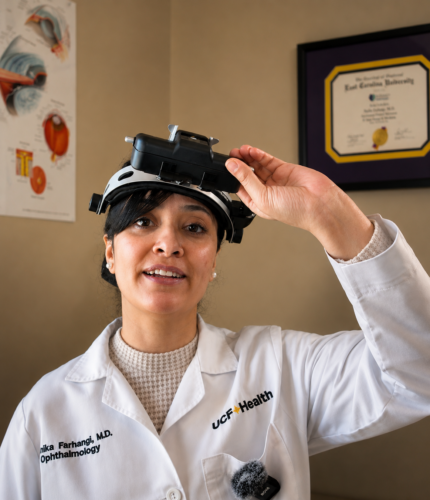
That observation, shared by Dr. Monika Farhangi in a recent video, captures something profound about living with cataracts. Vision loss is so gradual that many people simply adjust: Giving up night driving, avoiding bright rooms, quietly accepting the blur as a normal part of aging. It isn’t. And for patients in the Lake Nona and greater Orlando area, Dr. Farhangi offers a clear path forward.
As a board-certified comprehensive ophthalmologist and refractive cataract surgeon at UCF Health, the faculty physician practice of the UCF College of Medicine, Dr. Farhangi combines cutting-edge surgical expertise with a deeply patient-centered philosophy.
“That’s why I make sure that each patient leave their visit feeling informed, comfortable and empowered -not only about the procedure, but also about what their life will look like right after their surgery.”
Dr. Monika Farhangi
What Are Cataracts, and How Do They Affect Daily Life?
A cataract is the clouding of the eye’s natural lens, which sits behind the iris and pupil. Over time, typically as a result of aging (though other factors can contribute), proteins in the lens clump together and cause progressive clouding. This gradually dims, blurs, or yellows vision.
Cataracts are the leading cause of vision loss in adults over 40 in the United States, and cataract surgery is one of the most commonly performed and safest surgical procedures in medicine. Still, many patients delay treatment out of fear or uncertainty about what to expect.
Common Signs You May Have Cataracts
Blurry or hazy vision
Objects appear foggy or out of focus even with glasses
Glare & light sensitivity
Bright lights cause halos, starburst effects, or discomfort
Difficulty driving at night
Oncoming headlights feel blinding or disorienting
Colors appear faded or yellow
The world looks washed out or tinted, especially blues and purples
Frequent prescription changes
Your glasses or contacts prescription keeps changing without lasting improvement
Gradual adaptation
You’ve quietly stopped doing activities you used to enjoy because of vision issues
Seeing Clearly Again: Understanding Cataract Surgery
One of the most important things Dr. Farhangi emphasizes is this: the anxiety around cataract surgery is almost always larger than the procedure itself. Cataract surgery is outpatient, takes about 15–20 minutes per eye, and most patients notice dramatically improved vision within 24–48 hours.
“Many patients may delay their cataract surgery because they might be nervous, or simply don’t know what to expect. What I have learned is that the fear is not only about the procedure. It’s also about the unknown”
Dr. Monika Farhangi
Your Journey, Step by Step
1
Comprehensive Eye Exam & Consultation
Dr. Farhangi performs a detailed assessment of your vision, cataracts, and overall ocular health. She reviews your lifestyle and goals to recommend the best lens option for you.
2
Pre-Operative Planning
Advanced measurements are taken to precisely calculate your intraocular lens (IOL) power. You’ll receive clear instructions on medications, eating, and what to expect the day of surgery.
3
Day of Surgery
The procedure is performed under local anesthesia with sedation. You’ll be relaxed and comfortable. The clouded lens is gently removed using ultrasound (phacoemulsification) and replaced with your chosen IOL. Most patients feel no pain.
4
Same-Day Recovery
You’ll rest briefly at the surgery center, then go home. A protective shield is worn over the eye that night. Many patients notice improved vision within the first day.
5
Follow-Up & Full Recovery
Dr. Farhangi schedules post-operative visits to monitor healing. Full recovery takes approximately 4–6 weeks. Most patients can return to most daily activities within days.
Meet Dr. Monika Farhangi: Your Specialist at UCF Health
A UCF College of Medicine alumna, Dr. Farhangi completed a research fellowship at the prestigious Bascom Palmer Eye Institute and her residency at Howard University Hospital in Washington, D.C. She has published multiple peer-reviewed studies, presented at national ophthalmology conferences, and is deeply committed to training the next generation of physicians. She speaks English, Farsi, and Persian.
- English
- Farsi
- Persian
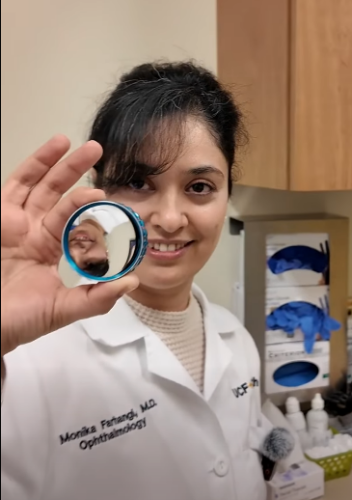
For Dr. Farhangi, returning to practice in the Central Florida community where she trained carries deep personal meaning.
“I attended UCF College of Medicine,” she shared. “So coming back and serving patients in this community has been incredibly meaningful for me.”
That connection shows in her approach. She knows that fear of the unknown is often the biggest barrier between a patient and life-changing surgery. Her response is transparency: walking patients through exactly what will happen, what recovery looks like, and how their daily life will improve on the other side.
Choosing the Right Lens: Your Premium IOL Options
One of the most empowering aspects of modern cataract surgery is the ability to choose a lens that fits your life. Dr. Farhangi takes time to understand each patient’s daily activities, hobbies, and visual priorities before recommending a lens type.
Lens Type
Best For
Glasses After Surgery?
Monofocal IOL
Excellent distance (or near) vision; simple, reliable option
Likely needed for some distances
Toric IOL
Patients with astigmatism; corrects corneal irregularity
Reduced dependence; may still need reading glasses
Multifocal IOL
Patients who want to minimize glasses for distance and reading
Significantly reduced or eliminated
EDOF (Extended Depth of Focus)
Intermediate and distance tasks; driving, computer use
Minimal; may need glasses for fine print only
Why Choose UCF Health for Cataract Surgery in Central Florida?
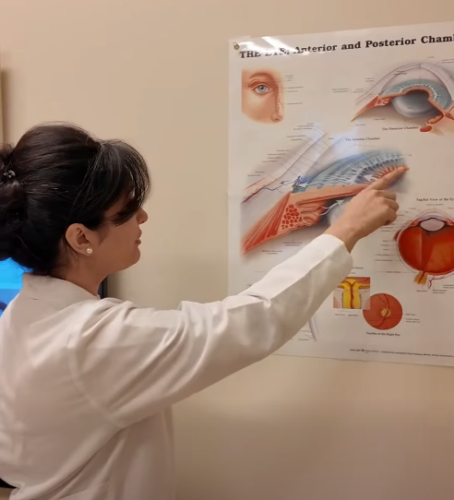
UCF Health’s ophthalmology program brings academic medicine’s best to the Lake Nona community. Physicians like Dr. Farhangi are not only clinicians: They are researchers, educators, and innovators who stay at the forefront of their specialty.
For patients in Lake Nona, Orlando, Kissimmee, St. Cloud, and surrounding areas of Central Florida, UCF Health offers accessible, world-class eye care without traveling out of the region. The practice accepts most major insurance plans. To confirm coverage or schedule an appointment, call 407-266-3627 or click here.
Frequently Asked Questions
Answers to the most common questions about cataract surgery and Dr. Farhangi’s practice at UCF Health.
Cataract Surgery Questions
Cataract surgery is a safe, outpatient procedure where the eye’s clouded natural lens is removed and replaced with a clear artificial intraocular lens (IOL). Using a technique called phacoemulsification, the lens is broken up with ultrasound energy and gently removed through a tiny incision. Most procedures take 15–20 minutes, and patients typically notice significantly improved vision within 24–48 hours.
If you’re experiencing blurry vision, glare, difficulty driving at night, or colors that appear faded or yellowed, cataracts may be affecting your quality of life. Many people gradually adapt without realizing it. A comprehensive eye exam with Dr. Farhangi can determine whether cataracts are the cause and whether surgery is the right step for you.
No. Surgery is performed under local anesthesia with sedation. Patients are awake but relaxed and should feel no pain during the procedure. Mild scratchiness or discomfort in the first day or two afterward is common and manageable with prescribed eye drops.
Patients can choose from monofocal lenses (focused for one distance), toric lenses (correcting astigmatism), and premium multifocal or extended depth-of-focus (EDOF) lenses that significantly reduce or eliminate dependence on glasses. Dr. Farhangi carefully discusses each option based on your lifestyle and visual goals.
Most patients see dramatic improvement within 24–48 hours. Full healing typically takes 4–6 weeks. During recovery, patients are advised to avoid rubbing the eye, heavy lifting, and swimming. Most daily activities — including reading, working, and watching TV — can be resumed within days.
Dr. Monika Farhangi questions
Yes. Dr. Farhangi welcomes new patients at UCF Health in Lake Nona, Florida. Appointments can be scheduled online or by calling 407-266-3627. UCF Health accepts most major insurance plans.
Dr. Farhangi practices at UCF Health’s Lake Nona location in Orlando, Florida — part of the UCF College of Medicine faculty physician practice. UCF Health serves patients throughout Central Florida including Lake Nona, Orlando, Kissimmee, and St. Cloud.
Post Tags
- cataract cataract surgeon cataract surgery cataracts eye doctor Opthalmology